Cloak
DOCUMENT ANONYMISER
A Chrome extension that catches a file on its way to ChatGPT, Claude, Gemini, Grok or Copilot, redacts what it finds, and uploads the masked copy instead. Detection runs across six OCR engines and maps every span back to pixel coordinates. Nothing reaches a server, because there is no server.
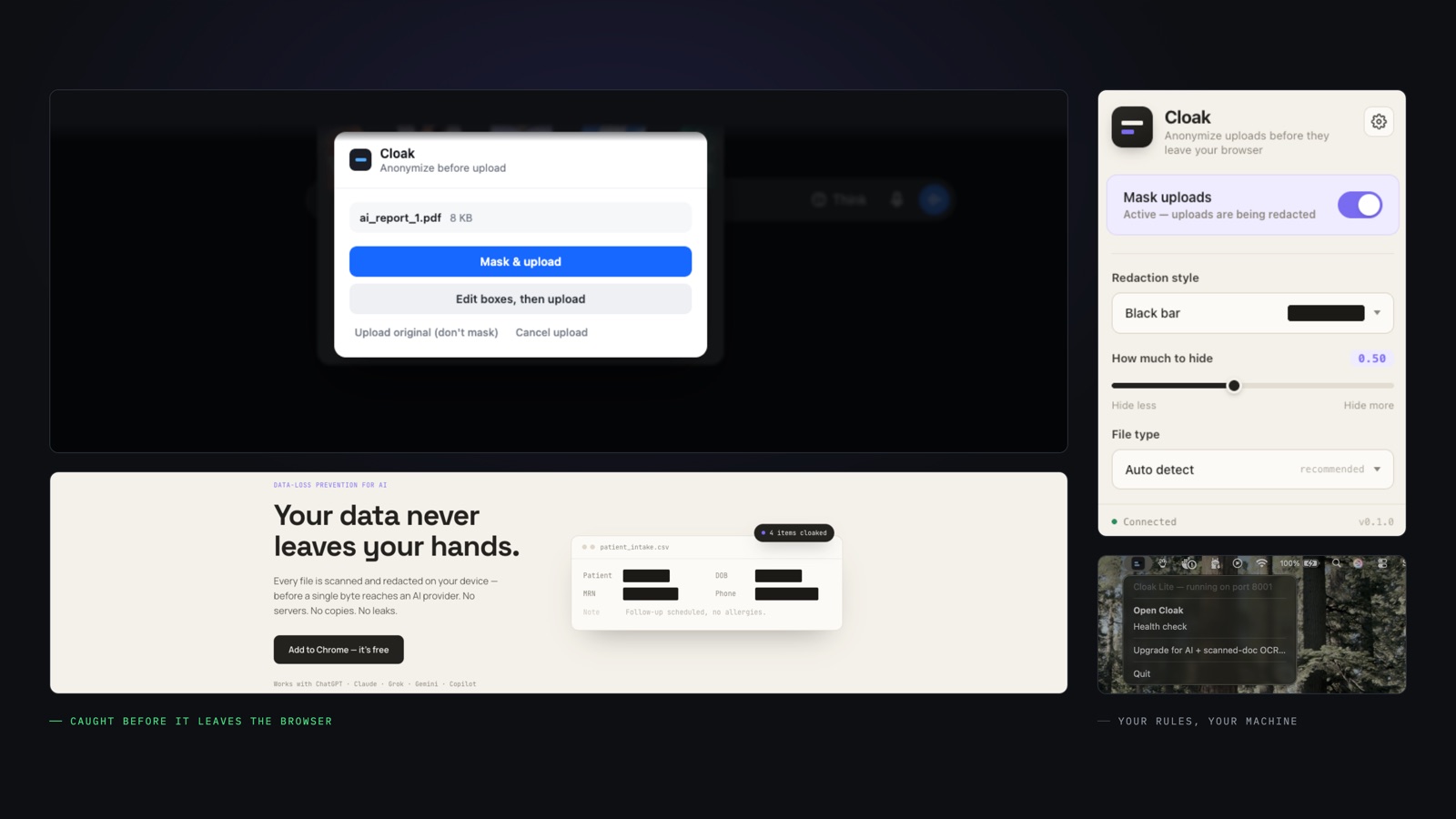
Cloak exists because the safest way to handle a sensitive document is to never let it leave the machine. It runs entirely offline, and gets more accurate as you add optional engines rather than less usable without them.
Detection is an ensemble: regex validators that actually check their checksums (Luhn for cards, mod-97 for IBAN), Shannon-entropy scanning for secrets like JWTs and API keys, GLiNER zero-shot NER, and Microsoft Presidio. Their spans get reconciled before anything is drawn over.
OCR engines, PII detectors and redaction styles are all swappable registries — a plugin drops in with one register() call. The same synchronous core drives a Python library, a CLI, a local FastAPI server, a macOS menu-bar companion and the extension itself.
It shipped: the extension is free at trycloak.in, and the companion app runs a Lite tier locally with a paid upgrade for AI detection and scanned-document OCR. Where the automatic pass is not enough, an editor lets you drag redaction boxes onto the page yourself before anything is sent.
STACK, BY LAYER
- 01 PRODUCT Chrome extension · macOS menu-bar app · box editor · CLI
- 02 SERVICE FastAPI REST server with async job management
- 03 DATA Job store · artefact storage · structured logging
- 04 MODELS GLiNER · Presidio · Surya VLM · Tesseract · PaddleOCR · RapidOCR
- 05 PROTOCOL —
- 06 FIRMWARE —
- 07 SILICON —