OpenRecall
WEARABLE AI MEMORY
A wearable that hears what you hear and remembers it, split into three tiers that build and test independently. The device is dumb by design, and refuses to do anything it cannot cryptographically verify you asked for.
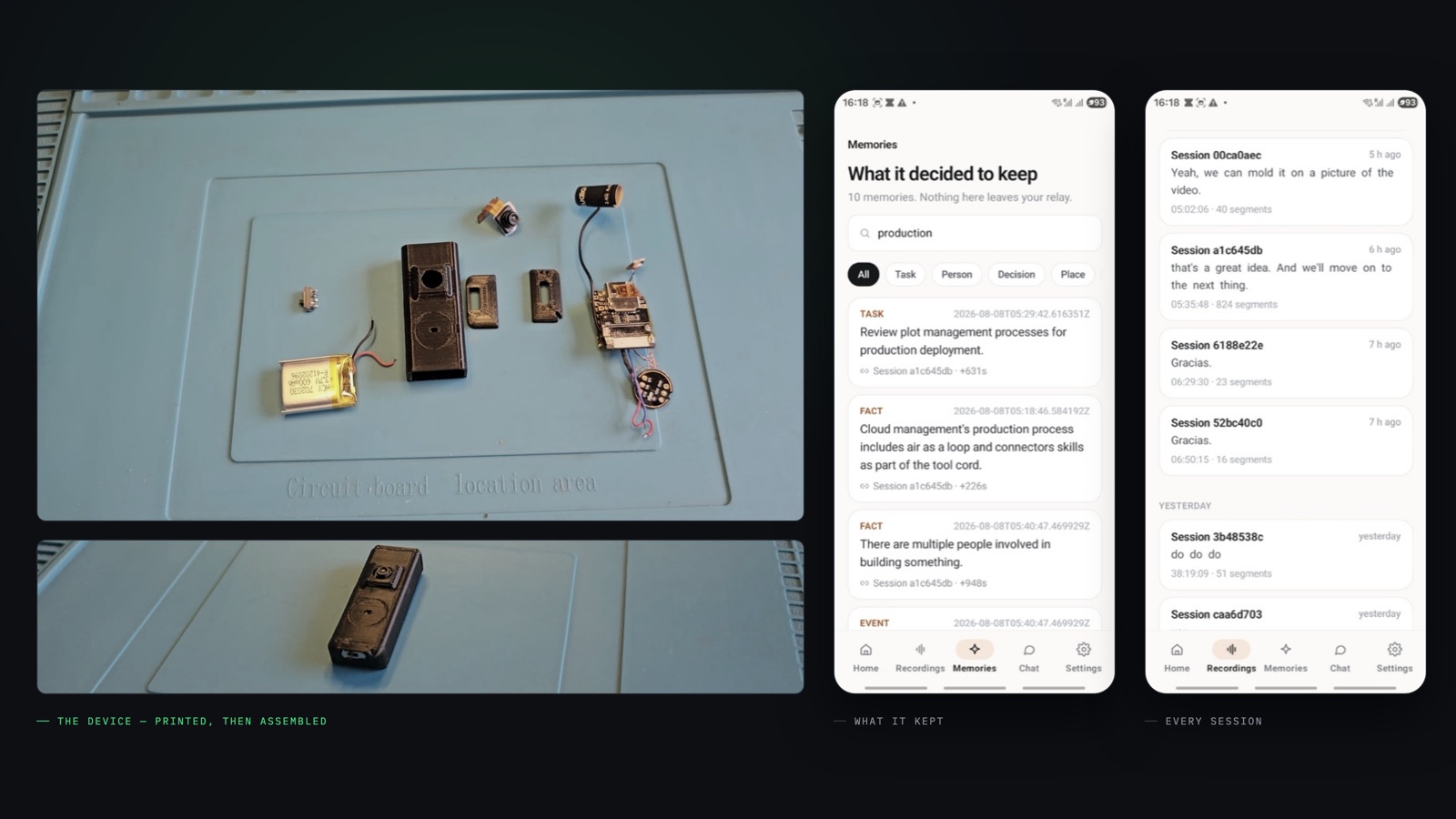
Same idea as Pin, rebuilt a tier deeper. Pin saw; this one hears — and this time the boundaries between the parts are contracts rather than conveniences.
The wearable does capture, gate, encode and stream: DMA I²S into a VAD, into Opus, into a ring buffer that spills to SD when the link drops. It has no wake word, no speech recognition and no language model on board, and it verifies an Ed25519 signature before executing any inbound command.
A Kotlin relay on the phone forwards audio verbatim and owns all the session bookkeeping, so the device never has to. The Python server is the brain: transcription on MLX, memory extraction, retrieval, and the agent that acts on any of it — all of it on your own hardware.
STACK, BY LAYER
- 01 PRODUCT Android relay app · recall and control surface
- 02 SERVICE aiohttp WebSocket gateway + HTTP control API
- 03 DATA Transcripts · memories · embeddings · on-device SD spill
- 04 MODELS MLX transcription · memory extraction · retrieval
- 05 PROTOCOL §C.6 audio · §D signed commands · §E session framing
- 06 FIRMWARE ESP-IDF · NimBLE · DMA I²S · Opus · ring buffer · Ed25519
- 07 SILICON XIAO ESP32-S3 Sense · mic · SD card · battery